Building Trust in Pet Food: Why Safety Starts Long Before the Bowl
09 November 2026
Working in pet food regulation, I sometimes come across comments suggesting that pet food is produced in a largely unregulated environment, or that there aren't sufficient safeguards and controls in place to ensure our pets are eating safe, healthy and nutritious food at every meal.
And I'll be honest, that can be frustrating to hear.
Having worked in the pet food industry for over 33 years, across different roles and organisations, I've seen first-hand the work that goes into producing safe pet food. From technical and quality teams to factory staff and regulatory specialists, there are people across the industry whose everyday responsibilities include managing risks, maintaining standards and continually improving how pet food is made.
Yet much of this work is invisible to pet owners.
When you pick up a bag, pouch, tin or tray of pet food, you don't see the legislation, supplier approvals, ingredient specifications, hygiene controls, traceability records, audits or testing that sit behind it.
But they are there.
Pet food is subject to over 50 pieces of legislation, and the UK is a proud champion of some of the highest feed safety and animal welfare standards in the world.
This is the industry I know, and it's very different from some of the perceptions that circulate, particularly online. Much of the work that goes into keeping pet food safe happens behind the scenes, and I think it's important that pet owners understand the safeguards already in place.
Pet food safety isn't based on a single test at the end of a production line. It is built into the whole process.
More aligned with human food production than you might think
One thing that may surprise pet owners, is just how closely aligned the fundamental safety principles behind pet food production are with those which cover the food we eat ourselves.
Pet food is legally classed as feed, but it sits within the same overarching General Food Law framework. Regulation (EC) No 178/2002 applies to both food and feed and establishes principles around safety, traceability and the responsibilities of businesses throughout production, processing and distribution.
But that is only the starting point.
Pet food businesses are also subject to specific feed legislation, including the Feed Hygiene Regulation, Regulation (EC) No 183/2005. This sets requirements around feed hygiene and requires feed businesses to implement permanent written procedures based on HACCP principles.
HACCP stands for Hazard Analysis and Critical Control Points. It will be familiar to anyone working in human food production. Put simply, it means looking systematically at what could go wrong, identifying the hazards that matter, putting appropriate controls in place and verifying that those controls are working.
There is also a very straightforward legal principle behind all of this: feed has to be safe! Regulation (EC) No 767/2009 states that feed may only be placed on the market and used if it is safe.
So, while the detailed legislation applying to human food and pet food isn't identical, many of the fundamental principles of safe production are aligned: business responsibility, HACCP, hygiene, traceability, controlled processes and verification.
It starts before an ingredient reaches the factory
Making safe pet food starts with understanding the ingredients being used.
Manufacturers need to know what they are buying, where it has come from and what potential hazards need to be considered. Depending on the ingredient, those hazards might be biological, chemical, physical or nutritional.
Supplier approval, specifications, traceability, intake checks and appropriate testing can all form part of the picture.
But it doesn't stop at checking ingredients when they arrive.
Manufacturers also need to consider how ingredients work together in a finished product, whether the formulation is nutritionally appropriate for the intended animal and whether changes to ingredients, suppliers or manufacturing processes introduce new risks.
A recipe change isn't simply a marketing decision. It may require technical, nutritional, regulatory and quality assessment before it is implemented.
There are also legal controls over the materials that can be used in animal feed.
Feed additives are a good example. They aren't simply unregulated "chemicals" that manufacturers can add as they choose. Regulation (EC) No 1831/2003 requires feed additives to be authorised and used according to the conditions of their authorisation.
Ingredients of animal origin have another layer of regulation.
What does "animal by-product" actually mean?
The term 'animal by-product' can sound off-putting, but its legal meaning is often misunderstood.
In simple terms, when permitted materials of animal origin are destined for pet food rather than human consumption, they fall under specific animal by-product regulations.
These can include ingredients from animals that have passed checks for human consumption, as well as certain animal-derived products that are no longer intended for the human food chain for commercial or other permitted reasons.
Importantly, 'animal by-product' is a legal classification. It doesn't mean waste, poor quality or an inherently inferior ingredient.
Many parts of an animal that we might not commonly eat in the UK can still provide safe, nutritious and valuable ingredients for our pets.
What are manufacturers actually controlling?
Food safety is about much more than bacteria.
The risk assessment behind pet food production can consider biological, chemical and physical hazards, as well as nutritional and formulation risks.
Biological hazards might include organisms such as Salmonella, Listeria and E. coli. Chemical hazards can include mycotoxins, pesticides, heavy metals, veterinary residues or cleaning residues. Physical hazards might include metal, glass, hard plastic or other foreign material.
There are also risks associated with formulation and processing. An incorrect inclusion of a vitamin or mineral, a processing failure, contamination after processing or an ingredient that doesn't meet specification may all need to be considered.
Then there are the controls that perhaps sound less exciting but are fundamental to producing safe food: cleaning, maintenance, pest control, staff hygiene, protective clothing, training, water quality, storage and transport.
Different products, ingredients, factories and manufacturing processes will present different risks.
That is precisely why food safety systems are risk based.
Testing matters, but it isn't the whole story
Testing and monitoring are important parts of pet food safety.
Depending on the product, ingredients, manufacturing process and hazards identified, businesses may need to monitor microbiological hazards such as Salmonella and Enterobacteriaceae, as well as chemical, physical or nutritional parameters.
Some testing is required by legislation, while other monitoring and verification activities are determined by a business's assessment of the risks associated with its products and processes.
But testing is only one part of a much bigger food safety system.
You cannot test every mouthful of every batch for every conceivable hazard.
Good food safety therefore relies on prevention and control throughout production, supported by appropriate sampling, analysis and verification.
It can be tempting to assume that the manufacturer carrying out the greatest number of finished product tests must make the safest food.
Food safety doesn't work quite like that.
Appropriate controls should be risk based and reflect the ingredients, product format, manufacturing process, suppliers and factory environment.
A strong food safety system aims to prevent problems occurring in the first place. That means understanding suppliers and raw materials, controlling the manufacturing environment, applying HACCP, maintaining good hygiene, monitoring processes, training people and then using appropriate sampling and testing to help verify that those controls are working. Testing verifies the system. It doesn't replace the system.
That is why statements such as "they don't test every batch" can be misleading when presented without any understanding of the wider food safety controls in place.
The number of finished product tests alone doesn't tell you how robust a manufacturer's food safety system is. What matters is whether the risks have been properly identified, controlled and appropriately verified.
Traceability matters too
Another fundamental part of both food and feed safety is knowing where things have come from and where they have gone.
Pet food businesses need appropriate records that allow ingredients and finished products to be traced through the supply chain.
Why does that matter?
Because if something does go wrong, businesses need to be able to identify potentially affected products, investigate what has happened and, where necessary, remove products from the market quickly.
Batch coding, traceability records, withdrawal procedures and recall systems all play a part.
No credible food safety system can promise that an incident will never occur.
What matters is having robust systems designed to reduce the likelihood of problems occurring, detect problems when they arise and respond effectively when something isn't right.
And a recall doesn't automatically mean that an entire product type, ingredient or manufacturing process is unsafe. It means something has been identified that requires action.
Then there is the label
The regulatory framework doesn't stop when manufacturing finishes. Pet food labelling is regulated too.
There are requirements covering the information that must be provided, how feed materials and additives are declared, analytical information and the claims businesses make about their products.
Understandably, pet owners can often find pet food labelling confusing, but unfortunately the language and terminology used on labels can sometimes be used as a means to spread concern or confusion. And this is something we work hard to help explain and we have a section on our website which has a number of factsheets to helps owners navigate any questions they might have about pet food labelling: Labelling | UK Pet Food
The claims made about pet food matter too. Whether a business is communicating nutritional benefits, functional properties, ingredient quality or manufacturing standards, those claims need to be accurate, supportable and not misleading.
Alongside legal requirements, FEDIAF's Code of Good Labelling Practice provides additional industry guidance on responsible communication. UK Pet Food members are also expected to comply with our Code of Conduct.
These frameworks help businesses communicate the benefits of their products without overstating the evidence or undermining confidence in other products.
Transparency is important, but so is making sure the information provided is meaningful, scientifically sound and useful to pet owners.
Regulation is the foundation, not the ceiling
Meeting the law is the starting point.
Responsible manufacturers often operate additional quality and food safety systems, audit suppliers and manufacturing sites, carry out additional monitoring and testing, and work to recognised certification and industry standards.
FEDIAF, the European pet food industry federation, has developed the Guide to Good Practice for the Manufacture of Safe Pet Foods, providing practical guidance to help manufacturers apply legal requirements and good manufacturing practices.
At UK Pet Food, we build on that work with additional sector specific guidance where appropriate. Our Guidelines for the Manufacture of Raw Pet Food, for example, were developed as an extension to the FEDIAF Guide, bringing together regulatory requirements and additional best practice for that sector.
That combination of legislation, regulatory oversight, industry good practice, business controls and technical expertise creates layers of protection.
And I think layers is the important word.
Making pet food safety more visible
Pet food safety is complex, and much of what keeps food safe happens behind the scenes.
Perhaps that is part of the reason misconceptions can take hold. We hear claims that pet food isn't properly regulated, that manufacturers don't test their food, that additives are unregulated chemicals, or that a recall proves an entire type of pet food is unsafe.
The reality is much more complex.
I have worked in this industry for many years, and I know there will always be opportunities to improve how we manage risks, share information and communicate with pet owners.
That is how responsible industries develop. Science advances, knowledge improves and practices evolve.
Behind every pack of pet food are legal requirements, scientific assessments, technical decisions, quality controls, monitoring systems and people who take their responsibilities seriously.
These are not always the things that make headlines. But they are the things that matter every day.
Safe pet food isn't simply tested at the end. It is built in from the beginning.
Building Trust in Pet Food: Key Takeaways
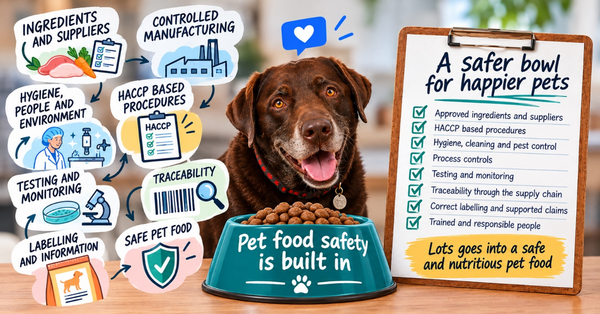
Pet food safety starts long before a product reaches the market. Manufacturers are responsible for ensuring their products are safe, supported by robust systems and controls that address the following essential requirements:
✅ Where ingredients come from and whether suppliers are appropriately approved
✅ What biological, chemical, physical and nutritional hazards may be relevant
✅ Whether formulations are nutritionally appropriate and changes have been properly assessed
✅ What controls are needed within the manufacturing process
✅ How hygiene, cleaning, pest control, storage and transport are managed
✅ How HACCP based procedures are applied and reviewed
✅ What testing and monitoring are appropriate to verify that controls are working
✅ How ingredients and finished products can be traced through the supply chain
✅ What would happen if a product needed to be withdrawn or recalled
✅ Whether the product is correctly labelled and claims can be supported
✅ Whether people are appropriately trained and understand their responsibilities
No single test or piece of legislation makes pet food safe. Safety comes from these controls working together, every day, throughout the whole process.
References and further reading
UK Pet Food: Industry guidelines and codes of practice
UK Pet Food brings together FEDIAF guidance alongside sector specific resources for pet food businesses.
https://www.ukpetfood.org/new-trade-zone/codes-of-practice.html
UK Pet Food: Guidelines for the Manufacture of Raw Pet Food
UK Pet Food's sector specific guidance summarises regulatory requirements and best practice for commercial raw pet food manufacture. It is intended to be read alongside the FEDIAF Guide to Good Practice for the Manufacture of Safe Pet Foods.
https://www.ukpetfood.org/resource/uk-pet-food-raw-pet-food-guidelines.html
FEDIAF: Guide to Good Practice for the Manufacture of Safe Pet Foods
Practical industry guidance supporting safe and hygienic pet food manufacture.
https://europeanpetfood.org/self-regulation/safety/
GOV.UK: Pet food guidance
Government information covering regulatory requirements applying to pet food.
https://www.gov.uk/government/publications/pet-food/pet-food
GOV.UK: Using animal by products to make pet food
Detailed guidance covering permitted animal by product materials, approvals and manufacturing requirements.
https://www.gov.uk/guidance/using-animal-by-products-to-make-pet-food
About Donna HollandDonna is Head of Technical & Regulatory Affairs at UK Pet Food, with more than 33 years’ experience in the pet food industry. She leads the Association’s work on food safety, technical and regulatory policy, working closely with industry, regulators, scientists and veterinary professionals. Outside work, she is also a pet owner to two 18-year-old cats and a 10-year-old dog.