Building Trust in Pet Food: Why How We Talk About Each Other Matters

By Donna Holland, Head of Technical & Regulatory Affairs at UK Pet Food
Working in Technical & Regulatory Affairs at UK Pet Food, I have a lot of conversations about pet food.
I speak with manufacturers across different feeding formats, technical and regulatory specialists, scientists, veterinary professionals and others across our sector. I also see many of the questions and concerns that arise when something about pet food gains traction on social media.
And, on reflection, one thing increasingly strikes me: how we talk about each other matters.
There is a huge amount of passion in the pet food world. That is something we should celebrate. We all care deeply about pets, their health and their wellbeing.
It is also a dynamic and highly competitive industry, and that competition can be a real force for good. It drives innovation, scientific progress and the development of products that benefit both pets and their owners.
And there is a lot to be proud of. I see fantastic campaigns and marketing every day that are creative, accurate and engaging, and that help pet owners understand the products available to them.
But competition can also create pressure to stand out, make a stronger claim or position one product against another in ways that are not always helpful to pet owners or to the wider industry.
We won’t always agree. We may have different views on nutrition, ingredients, processing, evidence or how particular risks should be managed. Healthy scientific debate and challenge are important.
But disagreement is very different from misinformation, disinformation, denigration and scaremongering.
And this is where I think we all have a role to play. I’d encourage everyone in our sector to take a moment to reflect on the content we see, share and create, including within our own organisations. Does it build confidence in our own product or brand, or does it rely on bringing another product, feeding approach or the wider pet food sector down?
If we challenge that thinking in our own communications as well as when we see it elsewhere, we can collectively help build greater trust in pet food.
Fear travels quickly
Scroll through social media and some familiar patterns emerge.
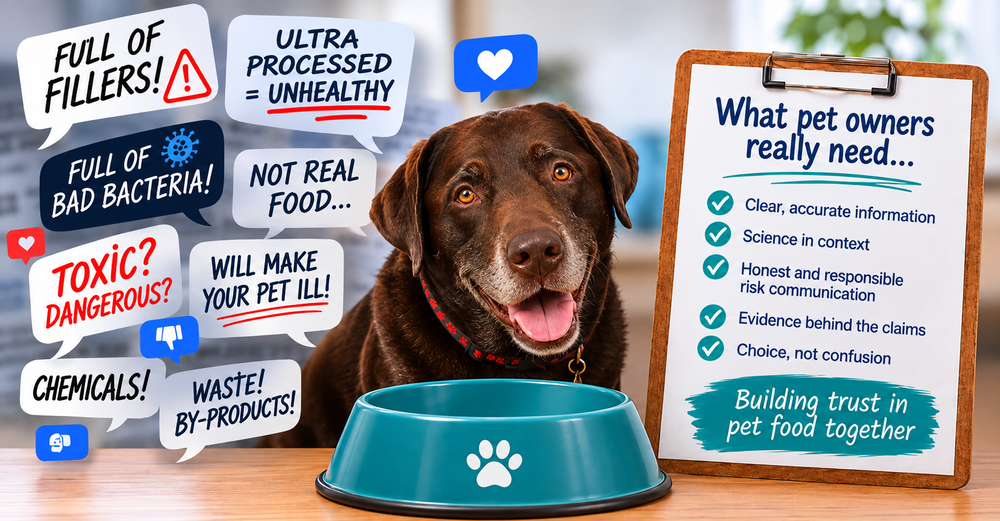
Ingredients can be talked about in ways that make them sound scary, often without much context. Processing is sometimes treated as automatically meaning a food is less healthy. Terms such as “chemical”, “filler”, “waste” and “by product” can be used to create concern rather than help pet owners understand what is actually in a food and why.
At the other end of the spectrum, certain feeding formats can be described as “full of bad bacteria”, inherently dangerous, or something that will make pets or their owners ill.
Studies may be reduced to a headline without explaining their limitations or wider context. An ingredient that is safe at the level used in a pet food, or a hazard that only presents a risk in particular circumstances, can be presented as evidence that harm is inevitable. Individual experiences can then be used as proof of what will happen to every pet.
And sometimes the message simply becomes:
“Our food is good because everyone else’s is bad.”
Fear is powerful. But is that really how we want to build trust? If we continually create doubt in pet owners’ minds about different diets, brands and feeding formats, we risk eroding trust in the pet food industry as a whole. Ultimately, everyone loses.
Hazard isn’t the same as risk
Food safety is a good example of why responsible communication matters. Identifying a hazard is important, but so is explaining the context and how that hazard is managed.
Different pet food formats present different hazards and require different controls. Raw pet food, for example, relies on measures such as careful sourcing, hygiene and temperature control. Dry food may use heat processing, moisture control and post-process hygiene to manage microbiological risks.
The principle is the same: understand the hazards and put appropriate controls in place to manage the risk.
There is a significant difference between saying:
“There is a hazard here that needs to be understood and appropriately managed.”
and:
“This food is full of dangerous bacteria and will make you or your pet sick.”
The first explains risk in context. The second creates fear.
Pet owners are caught in the middle
This matters because our pets are family.
Tell someone repeatedly that the food they have carefully chosen is poisoning their pet, causing disease or putting their family at risk, and we aren’t simply debating pet nutrition. We risk creating fear, guilt and anxiety across our whole industry – not just the competitor format or product the negative messages are initially aimed at.
This is also part of the thinking behind UK Pet Food's ‘Love Them Madly, Feed Them Wisely’ campaign. Against a backdrop of increasingly conflicting information about pet nutrition, the campaign provides pet owners with simple, clear and evidence-based information to help them make informed choices about what to feed their pets.
It is a principle that should extend to the way we communicate as an industry. Helping pet owners understand their choices, rather than making them fearful of them, will help build trust in pet food and ultimately benefit responsible manufacturers across all feeding formats.
The Food Standards Agency has recently highlighted the wider challenge posed by food misinformation and disinformation online and the importance of communicating evidence, risk and uncertainty clearly.
The Advertising Standards Authority has also addressed comparative and denigratory claims in pet food advertising. Its guidance reinforces an important principle: objective comparative claims need appropriate substantiation. Its rulings provide useful examples of where claims about other foods, health risks and competitors can cross the line.
This isn't about avoiding scrutiny or legitimate comparison. Comparative advertising has a place, but claims need to be accurate, evidence-based and capable of substantiation. Responsible communication should help consumers understand differences between products, not create unnecessary fear about alternatives.
Perhaps we should all reflect on that.
Your product doesn’t need somebody else’s to be bad for yours to be good
There is so much positive information we can give pet owners.
We can explain why a product has been formulated in a particular way, the nutritional approach behind it and why particular ingredients have been chosen.
We can talk about the expertise behind formulation, sourcing, manufacturing, food safety controls and quality systems.
We can explain the evidence behind the claims we make.
And we can be clear about who a product is designed for, and importantly when another option might be more appropriate.
That is confident marketing. And it builds trust without needing to undermine somebody else’s product.
Let’s celebrate choice
We are incredibly fortunate to have such a diverse pet food sector, with different formats, ingredients, textures and nutritional approaches available to owners. Dry, wet, raw and veterinary diets all have a place within a diverse and innovative market, giving pet owners a wide range of choices to suit their pets and their circumstances.
Pets are individuals and so are their owners. Their needs, circumstances, budgets, lifestyles and preferences differ. What matters most is that owners have access to safe, nutritious products and clear, accurate information that helps make informed choices.
As an industry, we should be confident enough to explain what makes our products good without needing to make another product bad.
Scientific challenge matters. Evidence matters. Responsible comparison matters. But so does the way we communicate.
Ultimately, trust in pet food isn’t built by creating fear. It’s built through transparency, evidence, responsible communication and giving pet owners the confidence to make informed choices for the animals they love.
Building Trust in Pet Food: Key Takeaways
Before we post, advertise, compare or comment on a product or feeding format, it is worth asking:
✅ Am I helping pet owners understand, or making them fearful?
✅ Have I explained risk in context, rather than focusing only on hazards?
✅ Is what I am saying accurate, evidence based and capable of substantiation?
✅ Am I promoting the strengths of my own product rather than denigrating someone else’s?
✅ Am I supporting informed choice rather than suggesting there is only one right answer?
✅ Would this communication leave a pet owner feeling more informed and confident, rather than confused, anxious or guilty?
If we can keep those questions in mind, we can help build greater trust in pet food as a whole.
That means being confident in what we do well, being responsible in how we talk about others and giving pet owners clear, accurate information they can trust.
References and further reading
Food Standards Agency: Why the FSA is stepping up to counter food misinformation and disinformation
https://food.blog.gov.uk/2026/05/12/why-the-fsa-is-stepping-up-to-counter-food-misinformation-and-disinformation/
Advertising Standards Authority: Pet food advertising guidance
https://www.asa.org.uk/advice-online/animals-pet-food.html
Advertising Standards Authority: Montdog Ltd t/a Wild Pack ruling
https://www.asa.org.uk/rulings/montdog-ltd-a24-1265514-montdog-ltd.html
#PetFood #PetNutrition #PetFoodIndustry #ConsumerTrust #ResponsibleMarketing #FoodSafety #RiskCommunication #PetHealth
About Donna Holland
Donna is Head of Technical & Regulatory Affairs at UK Pet Food, with more than 33 years’ experience in the pet food industry. She leads the Association’s work on food safety, technical and regulatory policy, working closely with industry, regulators, scientists and veterinary professionals. Outside work, she is also a pet owner to two 18-year-old cats and a 10-year-old dog.